Heading North to Understand Arctic Marine Mammals
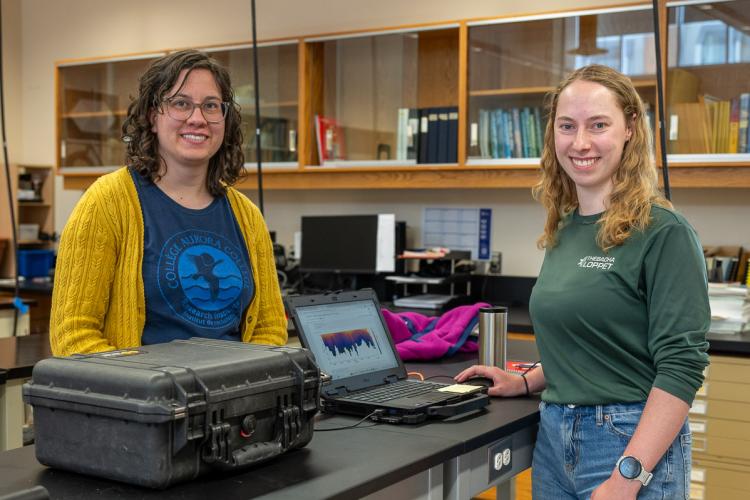
Dr. Tara Howatt is headed even further north this summer. The YukonU oceanographer and her team, including summer research student, Claire MacMillan, are deploying an underwater glider in the waters near Ulukhaktok, NWT to study how changing ocean conditions and underwater noise may be affecting arctic marine mammals.
The glider, owned by the Wildlife Conservation Society of Canada, moves throughout the water without a propellor. Instead, it dives and ascends by adjusting its buoyancy and pitch — compressing an air bladder, taking in water, and shifting an internal weight to adjust the angle up or down. As it glides, onboard sensors measure temperatures, depth, and salinity, and passive acoustic monitors measure sound.
“We're trying to look at different things that could be impacting marine mammals in the Arctic,” says Dr. Howatt. “Whether that's ocean conditions, which could be changing under climate change [or] underwater noise… from boating or shipping traffic.”
The team will work with local wildlife monitors and boat operators in Ulukhaktok to help with daily deployments. The data they collect will feed into biophysical surveys, the first step in establishing marine protected areas in the region.