The Yukon’s identity, who decides?
What is the identity of the Yukon when its image has been very much shaped from the outside.
If a Yukoner had a toonie for every time they’ve heard, the Yukon - that’s Alaska isn’t it?! we’d be able to buy ourselves endless double doubles, to cry into.
It could be said that the territory struggles with its identity, internally no - this identity crisis comes from outside, and it can refract and disorient identity within.
“When so much of your image is owned from the outside, that inevitably shapes how conversations happen on the inside,” says Yukon University cultural historian Drew Lyness.
Lyness, an Associate Professor in the school of Social Sciences and Humanities, explores these questions in his essay ‘Challenge of the Yukon: Visual Identity & Subsurface Narratives in the Phantasmagoric Klondike’ published in the latest issue of RACAR (The Canadian Art Review) in February 2026.
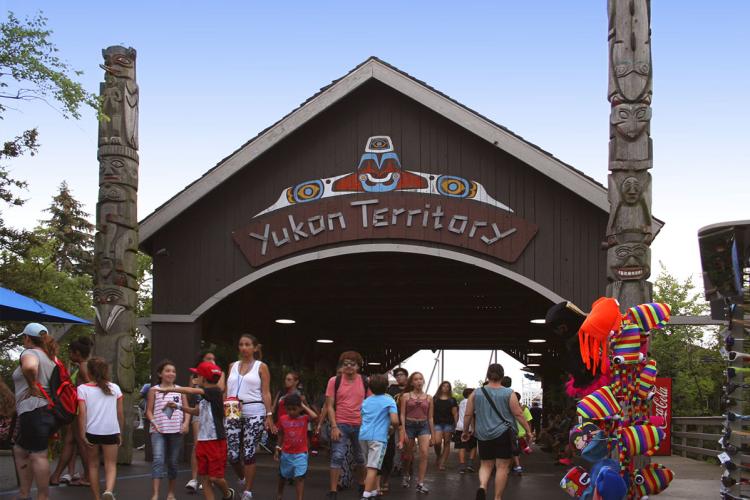
The journey in exploring these questions could be equated to a roller coaster ride. Irony perhaps because a Yukon Territory theme park still stands today at the Six Flags Great American Theme Park in Gurnee, Illinois that has welcomed hundreds of thousands of visitors over the years to its gold-rush themed attractions, further preserving the falsehoods of a Yukon story that isn’t entirely based on reality.
“The Yukon has reached far into American mass culture, often in ways that don’t reflect the reality up here.” Myths, Lyness says, aren’t useless, but they’re not enough in a territory that is rapidly coming under increasing geopolitical scrutiny.
That gap between reality and perception is exactly what Lyness is interested in. His research asks a deceptively simple question: who gets to define the Yukon?
“How much of the Yukon’s image is shaped someplace else?” he asks, “And how far does that narrative actually reach?”
Pretty far, it turns out. From the fiction of Jack London to Hollywood westerns and pop-culture tropes, the Klondike has been heavily folded into American frontier mythology for more than a century. “There’s a real cultural confusion,” Lyness says. “The Yukon isn’t really American history, but it’s absolutely part of American mythology.”
The gold rush itself was brief, but its afterlife has been long.
Mythology that still stands most clearly in Dawson City, where Lyness has spent a lot of time studying heritage, tourism, and the built environment. To visitors, Dawson looks like a perfectly preserved Klondike boomtown. Dig a little deeper, and the picture gets more complicated. “What we’re protecting has a relationship to the truth,” he says, “but it’s not the whole truth. Historians have long noted that the actual story of the Klondike gold rush was remarkably boring compared to the Hollywood razzmatazz it’s often remembered by.”
Many of Dawson’s historic-looking buildings are reconstructions, or facades rebuilt after fires or decay to maintain a particular gold-rush look. That wasn’t accidental. “This was a conscious choice,” Lyness says. “Heritage tourism became an economic strategy in the late 1950s, and at the time, was explicitly linked to the economic survival of the region.”
Institutions like Parks Canada have played a major role in shaping the ‘Klondike’ look. Heritage guidelines used in Dawson have been famously specific, right down to the finest architectural details, exterior paint colours, and specific fonts used on signage. While that creates a visually cohesive town, Lyness says it can also narrow the story. “It tends to flatten the region’s rich past into something more easily consumed by US tourists,” he explains, “especially when it comes to the histories of Yukon First Nations.”
That’s where art enters the conversation. A major part of Lyness’ work looks at how Yukon artists, particularly Indigenous artists, have been challenging gold-rush mythology for decades. “These conversations have been happening for a long time,” he says. “We just haven’t always put them in dialogue with each other.”
Symbols like dredges, for example, are being repurposed as metaphors, not just for mining, but for extraction more broadly.
“They become a way to talk about land, governance, language, and community,” Lyness says. Through sculpture, installation, and public art, Yukon artists are opening up space for more honest, contemporary stories about the territory and the people who live here.
In his essay Lyness isn’t trying to tear down the Yukon’s commodified and distorted exterior image. He’s trying to make room beside it. “This work is really about civic dialogue,” he says, “it’s about how popular culture and stories influence debates around mining, land use, environmental protection, and living up to the spirit and intent of political agreements in the territory.
For Drew Lyness, the goal is simple and timely. “This is a conversation about who Yukoners are today,” he says. “And about being honest enough with our history to figure out where we’re going next.”
Read the full essay
Challenge of the Yukon: Visual Identity & Subsurface Narratives in the Phantasmagoric Klondike: Racar
https://www.racar-racar.com/uploads/5/7/7/4/57749791/racar_502_08_lyness.pdf