Rethinking fuel breaks: How YukonU’s Jill Johnstone is helping northern communities proactively plan for fire
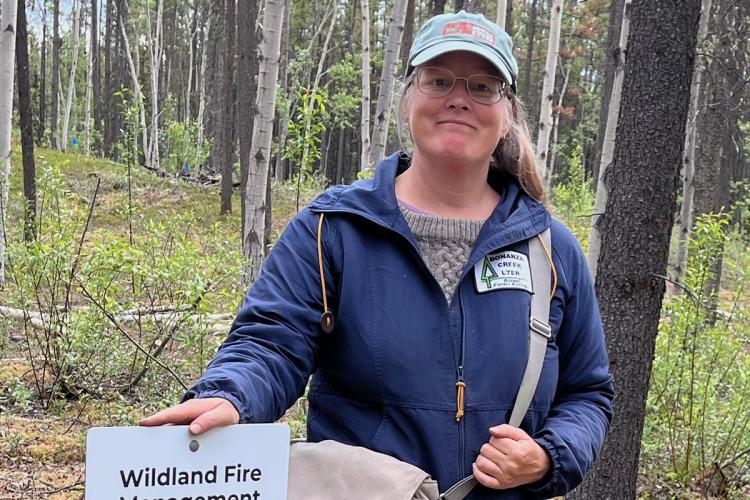
After more than three decades studying wildfire in the boreal forest, Jill Johnstone is clear about one thing: the environment she began researching 30 years ago, no longer exists.
“When I first started working … it wasn’t a particularly large field of interest,” she says, “fire was seen as a natural part of the boreal forest, something ecosystems had adapted to over centuries.”
That understanding still holds, but the volume and intensity of fires is changing the landscape faster than ever before.
“Twenty years ago I thought I had a pretty good handle on where things were going. Even ten years ago I felt that way, but not anymore.”
Jill is a Research Associate with Yukon University with the YU Research Centre and Affiliate Faculty at the University of Fairbanks. Her latest research grew out of the Morpho Sustainable Fuel Breaks Working Group at the National Center for Ecological Analysis and Synthesis at University of California, Santa Barbara.
Rather than working in isolation, Jill helped bring together fire managers, land managers, researchers, and community representatives, people who rarely sit at the same table to discuss the need for approaching fire mitigation differently.
“We wanted this to be more than an academic exercise,” she says. “We wanted something that could actually be used.”
The result is not just a research paper, but a suite of practical planning tools: case studies from northern communities, step-by-step roadmaps for fuel break design, and workshop templates that help communities identify their own priorities before implementation begins.
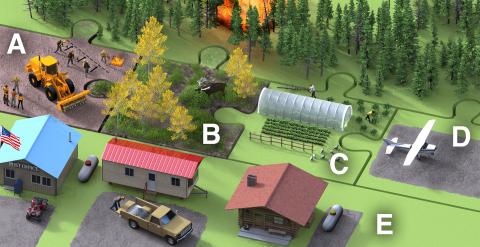
But as climate change pushes boreal fire response practices into uncharted territory, she believes now is the time to change practical approaches and adapt.
“To me, the most effective way forward is to put these tools in the hands of communities,” Jill says. “They understand best what will work for them.”
So, now communities need to adapt - and quick.
That uncertainty and the growing urgency it creates is what led Johnstone to focus the last chapter of her academic career on fuel breaks: strategically managed strips of land designed to slow or redirect wildfires.
And she’s convinced they can work, if they’re done differently.
Fuel breaks are increasingly common across boreal regions, especially near communities in the wildland–urban interface. But Johnstone is quick to point out a misconception.
“Fuel breaks don’t stop fires,” she says. “You can’t fireproof a landscape.”
Instead, fuel breaks create defensible space areas where firefighters can safely and strategically engage a fire. When planned in advance, they help communities avoid the dangerous, costly scramble of last-minute, reactive clearing.
“Reactive response is insufficient,” Johnstone says plainly. “And it’s very destabilizing [for the environment]. So why not think ahead and proactively.”
The problem, Jill explains, is that traditional fuel breaks are often designed as linear clear-cuts, a practice that can provoke strong opposition in northern communities with deep connections to surrounding forests.
“People who live adjacent to the forest are generally unhappy when it’s cleared,” she says. “Without careful planning, you can easily create an antagonistic relationship between agencies and communities.”
That social resistance can undermine even well-intentioned fire-risk reduction efforts.
Johnstone’s co-authored new study, published in iScience, argues that fuel breaks don’t have to be purely defensive infrastructure. With thoughtful design, they can become ecological and social assets.
Rather than re-establishing flammable conifer forests, Johnstone and her collaborators are testing fuel breaks planted with broadleaf deciduous species such as aspen and birch trees that are less likely to carry intense fire.
“These are species that are often considered weeds in commercial forestry,” she says. “But they’re exactly what we want for fuel breaks.”
As well in places like Whitehorse, Jill Johnstone’s home, fuel breaks are also being planted with berry species, including raspberries, saskatoons, and wild strawberries. The goal is to create landscapes that reduce fire risk while supporting wildlife, recreation, and traditional harvesting.
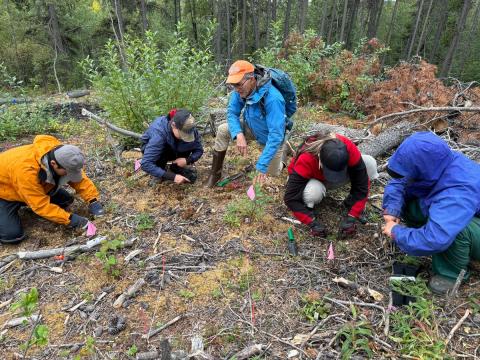
“When people start to see these spaces being used for walking dogs, gathering berries, or just enjoying the forest their perspective really shifts,” Johnstone says. “Fuel breaks can become a resource, not just a mitigation feature.”
The rethinking of the fuel break working group that Jill Johnstone was a part of crossed international borders.
“Ecosystems span international borders and we all benefit from sharing what we can across those borders”.
And for Jill Johnstone the work is deeply personal. “I care about what happens here,” she says, “This is my home.”