To split or not to split: a faster way to cure firewood?
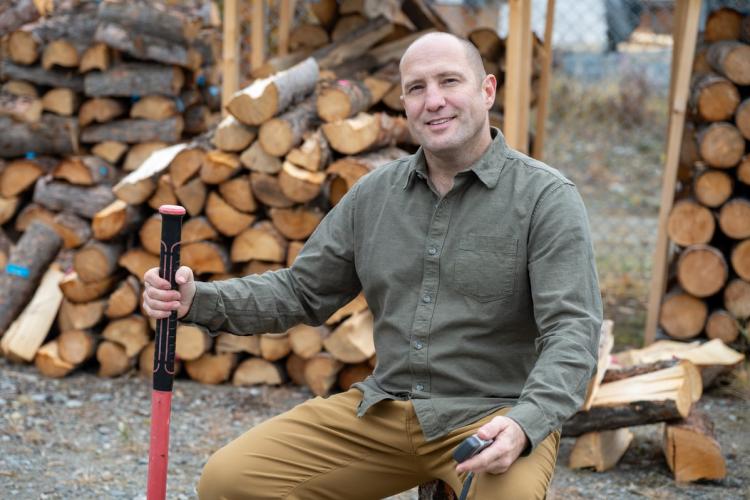
It was early October with the chill of oncoming winter in the air. We bundled up against the cold to meet Stephen Biggin-Pound to settle a distinctly northern debate – what’s the best way to stack and prepare firewood?
Stephen is the Chair of YukonU’s School of Academic and Skill Development, but he’s still finding time to advance forest ecology research in collaboration with the Forest Management Branch. We tracked him down in the yard behind the YukonU lab building, where various stacks and piles of firewood were set up to cure.
He crouches beside one pile and taps a log. “The increased surface area lets the
moisture escape much faster, and airflow around the stack really helps,” he says,
For many northern households, the wait for seasoned firewood can feel endless. Greenwood does not burn effectively or safely, so typically, freshly cut logs are left to dry for two or three years.
Passionate about blending science with practical solutions, Stephen had a hunch that he could speed things up. Grounded in years of northern field experience, studying forest dynamics and sustainable resource use, Stephen says, “I’m fascinated by how wood dries naturally,” he says, “but I’m also focused on people, how to make sure communities can prepare firewood safely, efficiently, and responsibly.”
His latest experiment set out to demonstrate that splitting green firewood could trim years off the wait while reducing the environmental impact of burning wet (green) wood.
Earlier in the summer, Biggin-Pound and his team set up a controlled experiment. They tested four wood-drying methods common in northern communities:
- Split Stacking – logs are split and stacked straight.
- Split Cross-Hatched Stacking – logs split and stacked with alternating layers to increase airflow.
- Round Stacking – unsplit logs stacked in a round pile.
- Four-Inch Round Stacking – smaller unsplit logs (4” / 12cm diameter) stacked in compact piles.
All logs began the season freshly cut, green, and with moisture levels ranging from 40% to 60%. From June through September, the team monitored the moisture levels, recording changes week by week. They wanted to figure out which methods brought moisture content below 20%, the ideal threshold for clean, efficient burning, by early October.
“Many people delay splitting because they think green wood is too hard to work with,” he explains. “They figure it’s better to let it dry first. But in reality, it’s not much harder. I split most of this wood by hand, and it wasn’t a big deal at all.”
When the first frost dusted the forest in early October, the results were unmistakable. Both split-and-stacked methods, cross-hatched and straight, reached an average moisture content of around 16%. That means the wood was fully dry and ready to burn after just one summer.
Meanwhile, the unsplit rounds and larger logs were still above 20% moisture, meaning they weren’t ready for efficient burning. Even smaller rounds, the size most people can fit into a wood stove, averaged around 20%, just barely ready.
“At first, we expected cross-hatching to outperform straight stacking,” Biggin-Pound says, brushing frost from a log. “But the data showed something interesting: splitting is the real game-changer. You don’t need the extra effort, the simple straight stack works just as well.”
This insight has enormous practical value for northern communities. By splitting wood immediately after cutting, households can prepare safe, efficient fuel in a single season instead of waiting years.
The Forest Management Branch plans to share these findings through community workshops and outreach, helping residents handle greenwood. “With more people accessing wood through land clearing and Fire Smart programs, it’s critical they know the right way to manage it,” he says.
By combining research with education, northern communities gain evidence-based guidance for sustainable firewood preparation. Split early, stack properly, and dry efficiently, and families can reduce smoke emissions, protect air quality, and ensure warmer homes during Yukon’s long winters.
Walking through the frost-kissed stacks, it’s easy to see how Stephen’s research bridges science and everyday life. “I love being out here in the forest, seeing the process unfold,” he says. “But at the end of the day, it’s about helping communities. If this research means someone can burn safer, cleaner fires this winter, that’s what matters.”