Trusting the Process: Mercedes’ Beadwork Journey in Watson Lake
By Lael Lund
In the depths of a Yukon winter, 17-year-old Mercedes Handel sat down for a conversation from her home in Watson Lake to talk about something that’s both deeply personal and quietly powerful in her life: beadwork.
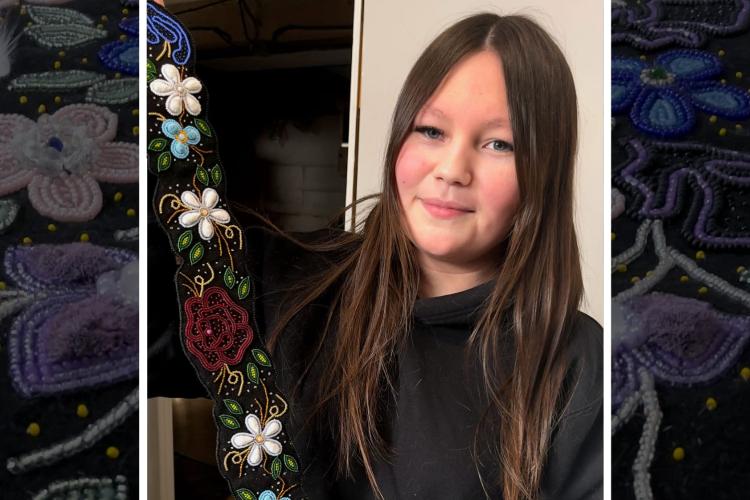
Mercedes doesn’t see herself as a “business owner” in the traditional sense. She calls beadwork a hobby that happens to bring in money sometimes. But as we talked, it became clear that what she’s doing is much more than a side hustle. Through hours at her desk after school, she’s carrying on a family tradition, nurturing a distinct artistic voice, and showing what youth-led, culture-rooted entrepreneurship can look like in a small northern community.
A Christmas Gift that Changed Everything
Mercedes began beading in December 2023, when she decided to make a Christmas gift for her grandma.
“I ended up making her a little pop socket with a small abalone centerpiece. It wasn’t anything crazy—but I just never stopped beading after that.”
Although she’d tried small beadwork projects in school, it had never really “stuck” as a hobby. She remembers being a kid, wanting to bead but hating the early projects she made. It wasn’t until she was about 15 that something clicked.
“After that first pop socket, I just kept on beading and beading and never stopped.”
Nerves, Facebook, and a Sell-out First Post
Not long after she started, Mercedes had a trip coming up. Her aunt suggested she try selling her beadwork to help pay for it. Posting her pieces to Facebook was a big step.
“I remember being so nervous posting it on Facebook. I was like, ‘No one’s even going to want to buy anything.’ And then within an hour, everything was bought.”
Even now, posting finished work still feels vulnerable.
“Every time I post something on Facebook of my beading, I still get nervous. I’m always thinking about how I can be better than the last project.”
For many new entrepreneurs and side-hustlers, that mix of fear and courage—sharing something deeply personal and hoping it lands—is part of the journey.
Beadwork as Living Culture
Beadwork is woven through Mercedes’ family story.
“I always grew up around beading. My mom, my sister, my auntie, my grandma, and my great grandma used to do embroidery. It’s always been around me.”
She draws from both her Tahltan and Kaska roots.
“What I do to incorporate my Tahltan side is I use Tahltan shapes that I put into my beading, and with Kaska it’s mostly florals whenever you think of Kaska beading.”
Older pieces inspire her colour choices, while her overall style leans modern.
“I do look at old beading to get inspiration from the colours, because their work is so colourful. I think my beading is more like a modern thing.”
Through this blend of traditional elements and contemporary design, Mercedes is helping carry forward a “lost tradition” in a way that feels true to her.
From Borrowed Beads to Belts and Sets
Like many young creators, Mercedes started with almost no supplies of her own.
“When I was first starting out beading, I had nothing of my own, so I was always using my auntie’s beads and thread. They would fight over the thread—‘No, it stays upstairs.’ ‘No, I need it downstairs.’”
Over time, she was gifted beading materials and built up her own collection.
“I don’t even remember when I bought enough beads. It just happened. When I put them in my little trolley thing, I realized I had a lot of beads.”
Today, her favourite projects are beaded belts and earrings.
“My favorite thing to bead are beaded belts. It’s a nice big project, but it isn’t a massive project. I love doing earrings too because you can make so many different types. The downside is I’m such a perfectionist—they have to be the exact same, but they’ll never be the exact same.”
Some belts come together quickly; others demand patience.
“Some belts only take me a week. One took me three or four days. But one belt took me the whole summer to make because I was just so tired.”
Her very first belt sat unfinished for months before she came back to edge it and complete the piece—an early lesson in stepping away, then returning with fresh energy.
Long Evenings, Deep Focus
Mercedes usually beads at a desk in her room, with her thread, needles, pencils, and beads laid out within reach. A show or music plays in the background, and time starts to slip.
“After school, I can do beadwork all the way till 10 o’clock. Or I’ll do it for three hours. Sometimes I’ll literally just sit at my desk all day and bead.”
She often experiences what’s called “flow state”—that feeling when you’re so immersed in what you’re doing that you lose track of time.
The way she approaches schoolwork is similar.
“It takes me the longest time to start an English project, but once I start, I’ll sit there and write until it’s finished. Starting is hard, but once I get into it, I’m into it. I think I’ve been like that for everything in my life.”
That combination of perfectionism and deep focus shows up in each bead, stitch, and pattern.
Designing in the Moment—and Trusting the Process
When she beads, Mercedes usually has a loose idea of her colour palette, but she decides a lot in the moment.
“I have a colour palette idea in mind, but I don’t follow a set colour palette. If I think this colour will look good on the project, then I’ll do that colour on the project.”
If something doesn’t feel right, she isn’t afraid to take it apart and redo it.
“There have been times where I definitely redid a flower because I didn’t like it and I knew it wasn’t going to work. Every time I take apart a flower and then redo it, it always comes out even better.”
Her guiding mantra comes up again and again:
“You just have to trust the process. It won’t look good until it’s completely finished.”
From Asking for Help to Owning her Craft
In the beginning, Mercedes leaned heavily on her auntie—for both supplies and know-how.
“When I was first starting out, I was really going to my auntie and being like, ‘What do you think about this? How do I do this?’”
Now she makes more decisions herself and shares finished projects with her family afterward.
“As I got more into beading, it’s kind of been more to myself. Once I finish a project, I will go up and show my auntie.”
Her auntie continues to be a trusted mentor, offering small refinements.
“She always tells me that she likes it, and if she notices something she’ll say, ‘You could trim that up more,’ or like, ‘Do that’—not in a bad way, but in a helpful way. You can always still learn when you’re beading.”
A Side Hustle with Clear Boundaries
Mercedes is in Grade 12, planning to graduate and go on to school. She knows beadwork will travel with her.
“For sure I’ll keep beading in school, because I know I’m going to be like a broke college student probably. I’m bringing all my beads and all my materials to school with me. The only thing that I am worried about is where I will find the space for all my beading stuff in my little dorm.”
She sells her work selectively, usually when she has a specific goal tied to her future.
“When something comes up—like if I need to fundraise for myself for a trip that’s helping me for my future goals—that’s when I’ll post some beading for extra money. If I’m just going on a fun trip, I don’t really do that. I just save my own money for that.”
Her raffles on Facebook often sell out quickly, but she’s intentional about not turning beadwork into a constant pressure.
“I never wanted beading to be like a job for me, like a full-time thing. I wanted it to be something I can do to relax. I never want to feel stressed out when I’m beading, because whatever you’re feeling when you’re beading, I feel like it goes into your work.”
Advice for New Beadworkers and Creative Side-Hustlers
Community members sometimes bring Mercedes their own beadwork and ask for her thoughts. Although she doesn’t yet see herself as a teacher of big groups, she’s clear on what she would say to anyone starting out.
“Stay consistent with beading, because no one’s first projects—or first couple of projects—are good. I remember when I first started beading, I thought this project was so good. Now I look at it and I’m like, it was alright.”
She also shares one practical rule she’s learned the hard way:
“Don’t buy cheap beads, because that just makes your beadwork look a little bit off. That just will throw your beadwork off.”
For young people in small communities who are considering turning a creative passion into a side hustle, Mercedes’ journey offers a grounded reminder:
“You just have to stay with it and learn along the way, or else you will never get better.”
At a desk in Watson Lake, surrounded by beads, patterns, and a few unfinished projects tucked under the bed, Mercedes is quietly proving that entrepreneurship can be rooted in culture, joy, and self-trust—and that sometimes, the bravest move is simply to keep going.