Sisters, Stories, and Kaska Worlds on the Page
By Lael Lund
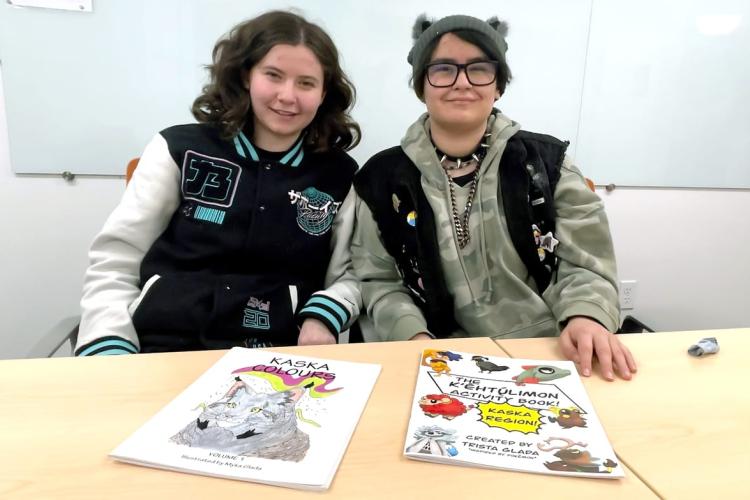
When sisters Myka Hake Glada and Trista Glada first moved to Faro, they weren’t thinking about product lines or entrepreneurship. They were grieving the loss of their mom, adjusting to a new home, and spending a lot of time indoors making art.
What started as a way to cope and create slowly grew into something bigger: two homegrown book projects that celebrate Yukon wildlife, Kaska language, and the imaginative worlds these young artists carry with them.
Today, Myka and Trista are known in Faro, Ross River, and beyond for their colouring and activity books—projects that honour their Kaska roots, connect with local kids, and build a new kind of confidence for the future.
From Rough Times to First Sales
The sisters’ journey began in a hard season. After their mom passed away, they lived with family and later moved in with Matt and Kara in Faro. Drawing became a steady part of their days—something they could return to when everything else felt uncertain.
Over time, selling art started to feel like a way to create independence. They began with small items—art cards, drawings, and buttons—and discovered that people were willing to pay for what they created. That simple realization set the stage for everything that followed.
As Myka puts it, none of it felt guaranteed:
“I just didn’t expect to become almost famous, and I just didn’t expect to actually sell my art. It’s a big, huge step for me at least. And I’m loving it so far.”
Myka’s “Kaska Colors”: Bringing Wildlife and Language Together
Myka’s first book, Kaska Colors, grew out of time spent with other people’s colouring books. She noticed how different art styles made her feel and began imagining what it would be like to create her own. The next question was what it should be about.
The answer came from home.
Myka wanted to celebrate Yukon wildlife—the plants and animals that shape everyday life in Faro, Ross River, and across the territory. Just as important, she wanted to contribute to keeping Kaska language present in a way that felt meaningful and accurate.
Kaska Colors features Yukon plants and animals, each paired with its Kaska name. To get those words right, Myka didn’t rely on the internet. She reached out to Kaska Elders in Ross River and to her uncle, artist and carver Dennis Shorty, who helped with language and terminology.
Myka describes the intention clearly:
“I went to different Kaska Elders… because I’ve heard the language is dying out slowly too… and I wanted to bring it back in a way. So I brought it back in my own way in the colouring book.”
The art itself took time. Myka practiced by watching drawing tutorials online—ravens, lynx, fish—and then translated those lessons into her own style. It wasn’t always easy.
“It was pretty difficult for me… I’d get frustrated with each drawing I messed up on. But I got it done in the end, and I’m happy with how it turned out.”
With help from a local printing partner in Whitehorse, Myka moved from hand-drawn pages to a professionally printed book that could be stocked locally and shared beyond Faro. One of her favourite moments happened at the Faro Rec Centre when someone she didn’t know recognized her from her work.
“Someone said they recognized me, and they said they have one of my colouring books. I was very happy… It was amazing.”
Trista’s “Kathulimon”: A Northern World Built for Kids
Originally, Kaska Colors was going to be a joint project, but Trista needed to step back for a time. When she was ready, she returned with something distinctly her own: a Kaska-inspired activity book built around creatures she calls Kathulimon.
Trista’s starting point was a lifelong love of Pokémon and video games—and the fact that many kids in Faro love them too. She wanted to create something that felt familiar and fun for young people, while still rooted in the North and shaped by her imagination.
“There’s one thing I always took in my life—it was Pokémon. I know a bunch of the kids in our hometown Faro love Pokémon, so I did that and turned it into a colouring book for the kids.”
Kathulimon is Trista’s own creature-world, inspired by Yukon animals and reimagined through her sketchbook. The book includes activities like spot-the-difference and counting pages, all guided by her original characters.
Like her sister, Trista leaned on community knowledge for language. Family and Elders supported terminology decisions along the way, ensuring the project stayed connected to Kaska roots.
Trista is also honest about the vulnerability of sharing something inspired by a beloved franchise, especially in a small community where people know you.
“I am a bit embarrassed by my book… because I feel like I might be ripping off Pokémon. They are inspired by Pokémon, but just something I’m a bit insecure about.”
Even with that insecurity, Trista keeps showing up for the work—reframing inspiration as a bridge to connect with kids who love the same things she does.
Learning, Mentorship, and a Whole Lot of Practice
Both sisters trace their artistic roots back to their mom, who was a skilled artist and gamer. That influence still shows up—not only in their drawing styles, but in how they think about stories, characters, and worlds.
Their learning paths look a little different. Myka’s development has leaned heavily on self-directed practice: long hours drawing, learning from tutorials, and gradually building skill through repetition. Trista has also pursued learning opportunities outside Faro, including art camps in Dawson and at Emily Carr in Vancouver, where she explored animation and painting.
“I was able to learn more painting skills and new skills in just drawing, or even new inspiration really.”
Mentorship has mattered too—especially in the middle stretch where a project can feel too big or too slow. Myka speaks warmly of Shelly Scott, who regularly visited, looked at her drawings, and pushed her to refine them.
“She’d come to our house… I’d be working on drawings for the colouring book… and she’s like, ‘Fix that,’ or ‘Do that.’… It might be frustrating at the moment, but it’ll be really worth it at the end.”
Entrepreneurship as Growth: Confidence, Community, and New Skills
Selling art hasn’t just brought in income. It has changed how the sisters see themselves.
Running tables at markets, talking with customers, and shipping books across Canada has stretched them beyond where they started. Trista, who once “barely left [her] room,” says the work has made her more social.
“Before… I barely left the house. After we moved in with Matt and Kara, they encouraged us to be more social and to work hard. I’m happy about that now.”
They’ve also learned practical business skills along the way: pricing, handling money, stocking local shops, and using Facebook to reach buyers beyond their town through community networks and word of mouth.
Both sisters have their own definition of success. For Trista, it isn’t mainly about profit.
“Honestly, I think success is having a good amount of fans and a supportive fan base… I don’t honestly think it’s about the money.”
Myka’s view is quieter but determined—she’s learning how to believe in her own potential while staying grounded.
“I feel I have potential… I want to at least keep an open mind and expect disappointment as well.”
Looking Forward: Birds, Graphic Novels, and Video Games
Neither sister is standing still.
Myka is working on Volume 2 of Kaska Colors, this time focused on Yukon birds—a nod to her dream of becoming an ornithologist. Each bird will come with a fun fact, combining her love of science, story, and art.
“In the future, I would love to become an ornithologist… [Volume 2] is gonna feature different birds that live in the Yukon… and each bird is gonna have a fun fact about them too.”
Trista’s imagination is racing in another direction: graphic novels, novels, and video games—both cozy story-based ideas and mascot-horror concepts grounded in the aesthetics she loves.
“I always wanted to make my own video game… either a nice calm game… or my own horror game. I love mascot horror games.”
Reading graphic novels pulled her into books; now she wants her own stories to do the same for other kids.
“I wasn’t fond of reading at first… I would just admire the art… Now I just want to create my own novels… like my own novel series.”
Advice for Small Town Dreamers
For young people in small Yukon communities who have a big idea but aren’t sure where to start, the sisters’ advice is simple and real.
From Myka:
“Have more patience… Don’t overwork yourself.”
From Trista:
“Think of things other people would like to see when they visit your hometown… and even also think about what things kids would want… Enter the mind of kids to see what they would like.”
Their story is still unfolding. They’re still in school, still experimenting, and still learning what it looks like to grow—especially as Trista moves to the “big city” while Myka stays in Faro.
But from a kitchen table covered in sketches to books that travel across the Yukon and beyond, they’ve already proven something powerful: you can start where you are, with what you love, and make something that matters to your community.